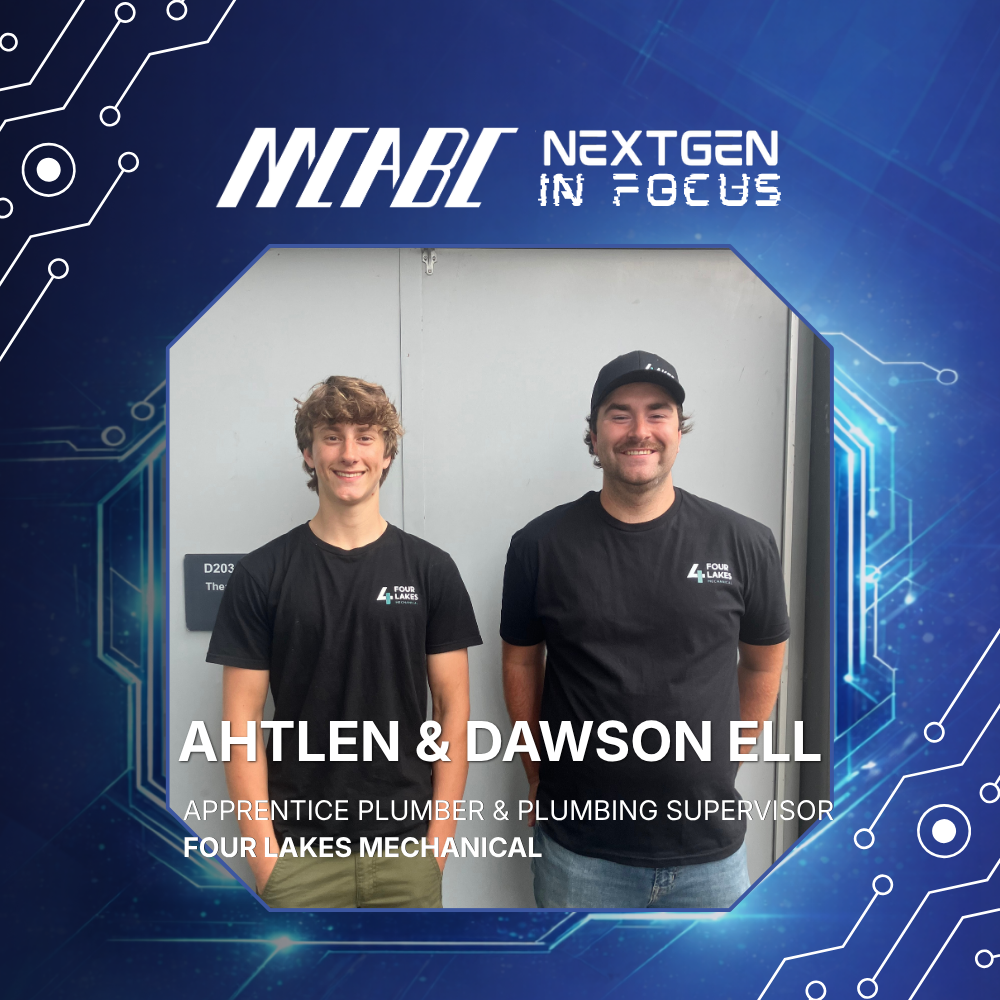
MCABC’s NextGen in Focus series highlights rising leaders across B.C.’s mechanical contracting industry—those building their careers through hands-on experience, mentorship, and a commitment to continuous growth.
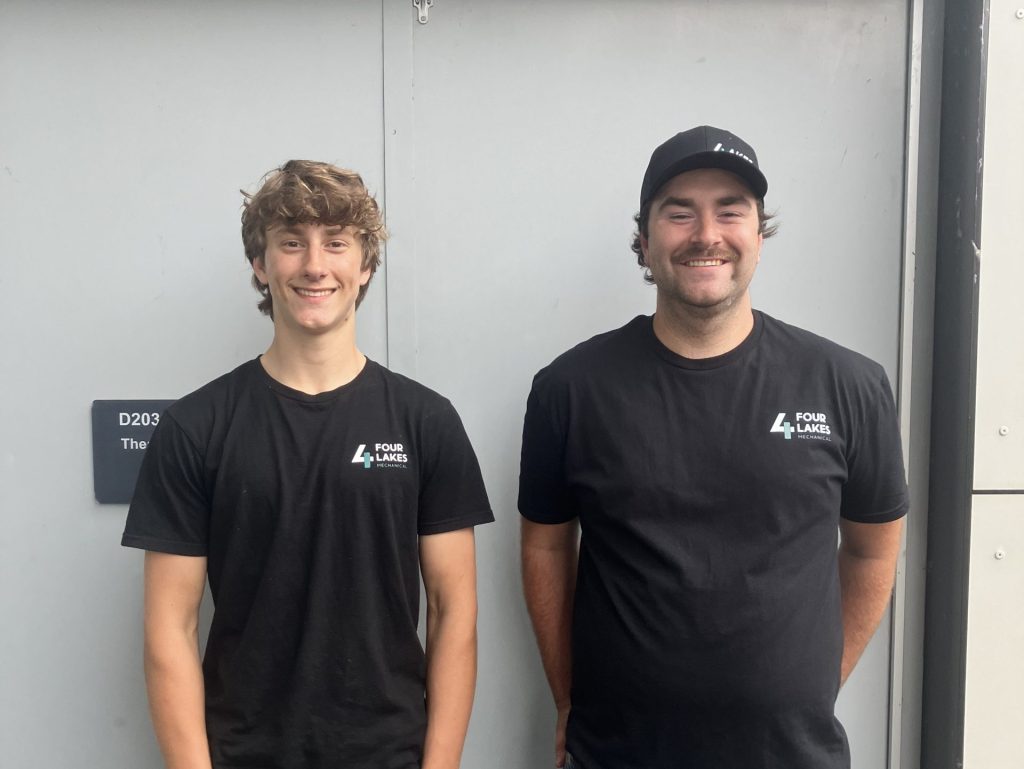
Ahtlen Ell, 17, Apprentice Plumber | Dawson Ell, 26, Plumbing Supervisor
For this instalment, Conor caught up with Dawson and Ahtlen Ell, two brothers employed by MCABC member Four Lakes Mechanical.
Fresh off an evening at the SD43 Trades Expo, the brothers had been busy engaging with students and showcasing careers in the mechanical trades through MCABC’s Youth Engagement Program.
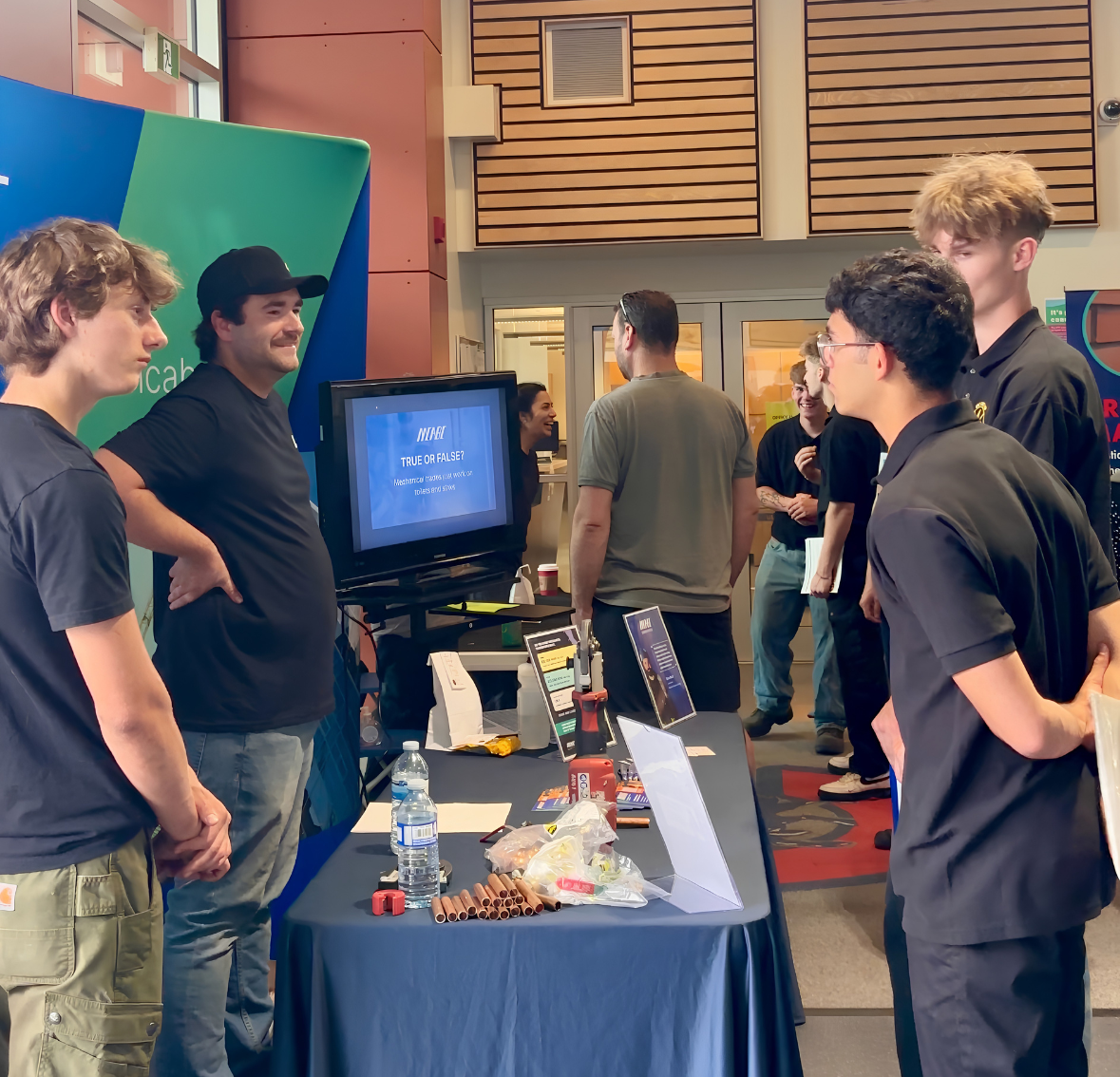
Ahtlen and Dawson interacting with students at the SD43 Skilled Trades Expo at Centennial Secondary School, Coquitlam.
The brothers shared their stories, advice for young people considering a career in the trades, their vision for the future of our industry, and more.
Read the full interview below!
What drew you to a career in the trades?
Dawson: I never saw myself in an office. I’ve always been a hands-on person. I also knew there was a lot of room for growth in the trades and that, if you work hard, you can make a really good living for you and your family.
Ahtlen: Yeah, absolutely. I love working with my hands—not sitting at a desk in front of a screen, just being out there doing it. It’s real life, you know? It also helped a lot to have Dawson go before me. I saw the path he was on and I was like, “Yeah, this is definitely for me.”
Why the mechanical trades? Why plumbing?
Dawson: Actually, I had my heart set on welding initially. For a couple of years I was dead-set on being a welder and had plans to take the foundations program after graduation. Then I started dating my now-wife and her father convinced me to try plumbing.
He said, “Dawson, just come and try it for three months. If you don’t like it, so be it. But if you like it, I’ll give you a job myself and pay for your schooling.” I figured there was no reason not to give it a go. So I did, and I never looked back.
Ahtlen: I never wanted to be a welder, ha! I was just fascinated by mechanical systems—how everything fits and works together, from heating to cooling systems and everything in-between. I just thought it was super interesting, and I wanted to learn more.
What do you enjoy most about your job and/or our industry?
Ahtlen: Hands down, the variety. Both in terms of what you’re doing and where you’re doing it. One week, you’re doing groundwork on an industrial project way up North outside Bella Coola, the next you’re down in the Lower Mainland working on a commercial tower, the week after that you’re in a remote village at the top of Harrison Lake working on an Indigenous community centre. Every day is different; it never gets boring. Not every Plumber is travelling around that much, but the opportunities are there if you want.
How did you get to where you are now?
Dawson: Honestly, it’s not complicated. In an industry like ours, there’s tonnes of opportunity to advance your career. It comes down to being on time, being eager to learn, and having the right attitude. Be early, be ready to work, apply yourself. I genuinely enjoy the work and always give 100% to whatever I’m working on. My employers saw that potential in me and kept giving me more responsibility, more opportunities to prove myself. And it just kept building from there. That’s the attitude I’ve had since I was a Level 1 Apprentice.
Speaking of apprenticeship, is there anything you’d like to see changed about how we currently train apprentices in B.C.?
Dawson: One area for improvement I see is around soft skills, things like emotional intelligence and learning how to communicate with other trades and workers. Every apprentice should be learning those things in school; they’re so important for on-site safety and performance.
Another one is around the foundations programs. I’d love to see more of an emphasis on actually working in the trade while you’re still in high school. You might enjoy it in a classroom or a workshop, but when you’re five-foot deep in a hole and it’s dark and two degrees and pouring rain—that’s when you find out if it’s really for you.
I’m a big advocate for work-based trades programs in high school because they allow you to really try it out and start building the skills before you even begin your apprenticeship. They set you up for success and you get more out of your apprenticeship because of it.
Ahtlen, you’re in one of these programs, aren’t you? Can you tell us about it?
Ahtlen: Yeah, it’s called the Work in Trades program. I went to my school’s guidance counsellor and told her I wanted to do an apprenticeship after graduating, and she told me about the program. Right now I’m going to school two days a week and the rest of the week I’m working as a Plumber. It sets you up really well because by the time you finish school and start your apprenticeship, you’ve already built up a lot of experience.
Dawson: If I can just add to that, I had about 800 hours before I started my Level 1. I’m not saying everyone needs to do that many hours before starting an apprenticeship, but it absolutely made me a better Plumber. When you have the practical knowledge first, and then add the theory in, it gives you a better overall understanding of the trade. It’s much harder to learn the other way around.
What do you wish more young people understood about the trades?
Ahtlen: It’s starting to change, but a lot of people still think they’re “too good” for the trades, as if the trades are for people who don’t have other career options. The trades take a lot of skill and discipline to be successful, and they’re one of the most challenging and rewarding jobs out there. They’re probably one of the only jobs that are safe from AI, too.
Dawson: Yeah, a lot of people think, “Oh, I’m failing school, I’ll just go into the trades.” It doesn’t work that way. You can fail in the trades too. Being a tradesperson is a demanding career and the industry is moving so fast, you have no choice but to be a lifelong learner in the trades. You’re not learning out of a textbook, but trust me—you’re always learning.
You guys are part of our industry’s next generation. One day, no doubt, you’ll be leading it. What’s your vision for the future?
Dawson: I’d like to see more collaboration between consultants, engineers, and the trades. There’s often a mismatch between what works on paper and real job-site conditions. Looking at lines on a drawing or even a 3D model is completely different from actually installing the systems and dealing with obstacles on-site. I’d love to work more hand-in-hand with mechanical engineers, so we can educate one another and, at the end of the day, make everyone’s life easier and deliver better solutions. I often wonder if engineers shouldn’t do part of their training with us so they understand the realities on the ground, and vice-versa for the tradespeople.
Ahtlen: For me it’s better communication and collaboration between the trades themselves. Just understanding how each other works and having respect for each other. More camaraderie too. We all have the same goal: show up, do a good job, finish the project on time and on budget, and go home safely. We’re all on the same team.
* * *
About
The Mechanical Contractors Association of B.C. (MCABC) is the only dedicated representative for the mechanical contracting industry in British Columbia—the industry with the largest share of skilled trades workers in the construction sector. As the connection to industry excellence for our diverse membership, we deliver education and professional development programs that enable high standards of practice and business success. Through advocacy and strong industry partnerships, we influence policy and regulatory development at all levels of government, advancing the interests of our industry and improving its ability to meet B.C.’s growing infrastructure demand.
Media Contact
Conor Brendan Dunne
Manager, Communications & Stakeholder Engagement
cdunne@mcabc.org
(604) 205-5058